
Introduction
Understanding the benefits and risks of artificial intelligence is important as AI continues to grow in different industries. Artificial Intelligence (AI) is no longer a concept from science fiction movies. It is already part of our daily lives—from voice assistants on our phones to recommendation systems on streaming platforms. As AI continues to grow rapidly, it brings both exciting opportunities and serious challenges.
Table of Contents
In this article, we will explore the main benefits and risks of artificial intelligence and understand how it may shape our future in the coming years—in simple and easy language. To understand this topic better, you should first learn what artificial intelligence is and how it works.
What Is Artificial Intelligence?
Artificial intelligence refers to computer systems that can perform tasks normally requiring human intelligence. These tasks include learning from data, recognizing patterns, understanding language, and making decisions.
Some common examples of AI include:
- Voice assistants like Siri and Alexa
- Recommendation systems on YouTube and Netflix
- Face recognition on smartphones
- Self-driving car technologies
AI systems learn by analyzing large amounts of data and improving their performance over time.
Major Benefits of Artificial Intelligence

The benefits and risks of artificial intelligence must be carefully balanced to ensure responsible use of technology. AI offers many advantages across different fields. Let us look at the most important benefits.
1. Increased Efficiency and Productivity
AI can work continuously without fatigue. It can process large amounts of information much faster than humans. This helps businesses and organizations complete tasks more quickly and accurately.
For example:
- Automated data analysis in companies
- Chatbots handling customer support
- AI systems managing logistics and inventory
This leads to improved productivity and reduced operational costs.
2. Improved Healthcare Services
AI is transforming modern healthcare in many ways.
- Detecting diseases from medical images
- Predicting patient risks
- Assisting doctors during surgeries
- Managing hospital records
Early detection of diseases like cancer using AI can save many lives. AI-powered tools also help doctors make more accurate diagnoses.
3. Personalized User Experiences
AI allows services to be tailored according to individual preferences.
Examples include:
- Personalized shopping recommendations
- Customized news feeds
- Music and movie suggestions
This makes digital services more convenient and enjoyable for users.
4. Enhanced Safety and Security
AI plays an important role in improving safety.
- Monitoring traffic systems
- Detecting fraud in financial transactions
- Identifying cyber threats
- Predicting equipment failures
In dangerous environments such as mining or space exploration, AI-powered robots can perform risky tasks safely.
5. Scientific Research and Innovation
AI accelerates scientific discoveries by analyzing complex data faster than humans.
It is helping in:
- Drug development
- Climate research
- Space exploration
- Material science
These advancements can solve major global problems more efficiently.
Major Risks of Artificial Intelligence
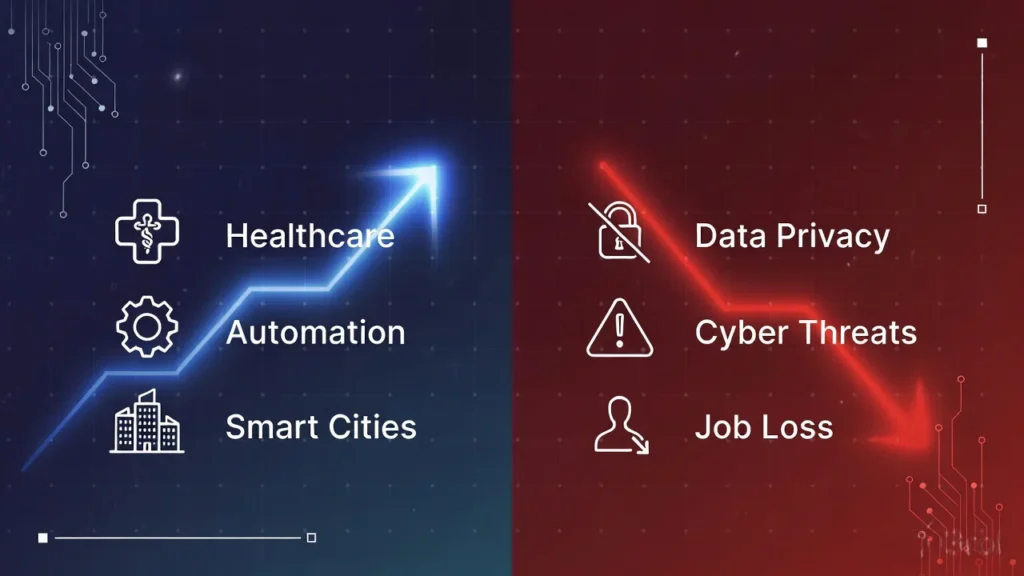
While discussing the benefits and risks of artificial intelligence, it is important to consider ethical and security concerns.
1. Job Displacement and Unemployment
One of the biggest concerns is that AI may replace many human jobs.
- Factory automation
- Customer service chatbots
- Self-checkout systems
- Autonomous vehicles
Although AI creates new jobs, it may eliminate traditional roles faster than new opportunities appear. This could increase unemployment if workers are not properly retrained.
2. Bias and Discrimination
AI systems learn from data provided by humans. If this data contains bias, the AI system may also become biased.
This can result in:
- Unfair hiring decisions
- Biased loan approvals
- Discrimination in law enforcement
Such outcomes can harm individuals and reduce trust in technology.
3. Privacy and Data Security Risks
AI systems require large amounts of personal data.
Risks include:
- Unauthorized data collection
- Surveillance without consent
- Data breaches and hacking
Protecting user privacy is one of the most important challenges in AI development.
4. Loss of Human Control
As AI systems become more complex, understanding their decisions becomes difficult.
This raises concerns such as:
- AI making critical decisions without transparency
- Autonomous weapons systems
- Machines acting unpredictably
Maintaining human oversight is essential to prevent dangerous outcomes.
5. Ethical and Moral Challenges
AI raises difficult ethical questions.
- Should AI be allowed to make life-and-death decisions?
- Who is responsible when AI makes a mistake?
- Can machines be trusted with legal authority?
Without clear regulations and ethical guidelines, AI could be misused in harmful ways.
What the Future Holds for Artificial Intelligence
The future of AI will likely be shaped by how well society balances innovation with responsibility.
Key trends expected in the future:
- More AI integration in healthcare and education
- Smarter virtual assistants
- Advanced robotics in daily life
- Stronger AI regulations and laws
- Greater focus on ethical AI development
AI will continue to grow, but governments, companies, and researchers must work together to ensure safe and fair use.
How Can We Use AI Responsibly?
To maximize benefits and reduce risks, several steps are important:
- Develop transparent AI systems
- Eliminate bias in training data
- Protect user privacy
- Provide job retraining programs
- Create strong legal frameworks
As technology evolves, the benefits and risks of artificial intelligence will shape the future of society and innovation
Conclusion
Artificial Intelligence holds enormous potential to improve our lives — from healthcare and education to safety and innovation. However, it also carries serious risks related to jobs, privacy, bias, and control.
The future of AI depends not only on technology but also on how wisely humans choose to use it. With proper regulation, ethical guidelines, and responsible design, AI can become one of humanity’s greatest achievements. Many experts continue to study the benefits and risks of artificial intelligence to ensure safe and effective adoption.