
🧠 Introduction
Artificial Intelligence has traditionally relied on powerful cloud servers to process large amounts of data. However, as smart devices become more advanced, a new approach known as Edge AI is gaining popularity.
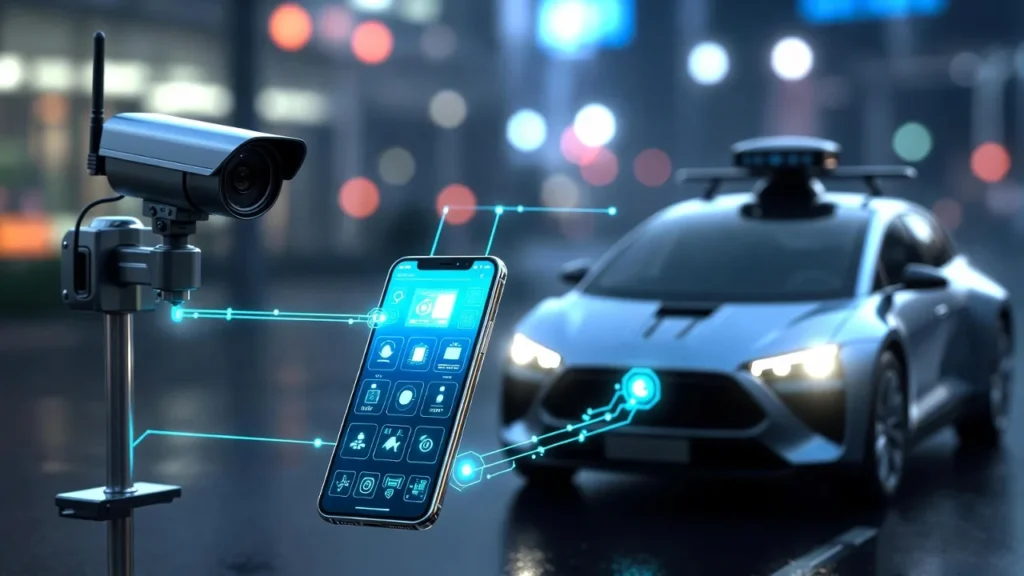
This technology allows artificial intelligence algorithms to run directly on local devices such as smartphones, sensors, cameras, and Internet of Things (IoT) systems. Instead of sending data to remote cloud servers for processing, these devices analyze data locally and make decisions instantly.
This technology is transforming industries by enabling faster responses, improved privacy, and reduced dependence on internet connectivity.
Table of Contents
⚙️ What Is Edge AI?
Edge AI refers to the deployment of artificial intelligence models directly on devices located at the “edge” of a network. The “edge” typically refers to devices such as smartphones, security cameras, autonomous vehicles, industrial machines, and smart home systems.
Unlike traditional cloud-based AI, where data must be transmitted to centralized servers for analysis, edge computing AI processes information locally on the device itself.
This allows systems to perform intelligent tasks such as object detection, voice recognition, and predictive analysis in real time.
The Internet of Things (IoT) refers to a network of physical devices—such as smart home appliances, wearable devices, sensors, and industrial machines—that are connected to the internet and able to exchange data. Edge computing AI is often used in IoT systems to process data directly on these devices instead of sending it to cloud servers. This allows IoT devices to make faster decisions, reduce network traffic, and improve privacy.
🌐 Edge AI vs Cloud AI
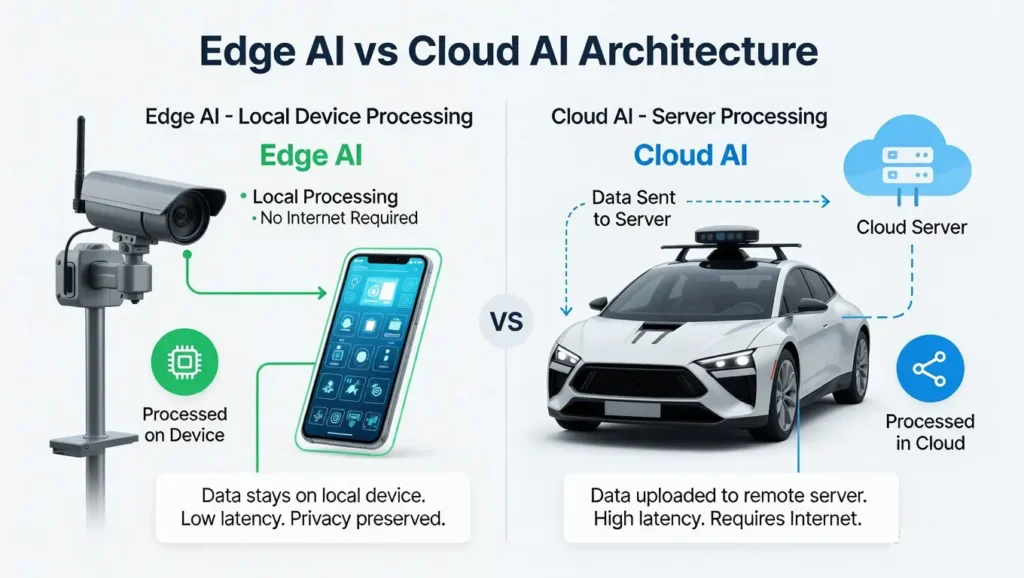
Both AI at the edge and cloud-based AI have important roles in modern technology. However, they differ in how data is processed.
Cloud AI
Cloud AI processes data on remote servers located in data centers. Devices send information to the cloud, where powerful computers analyze it and return the results.
Advantages of cloud AI include:
- High computational power
- Large data storage capacity
- Easier model updates
Edge AI
This technology processes data directly on local devices without needing constant cloud communication.
Advantages of on-device AI include:
- Faster response time
- Improved privacy and security
- Reduced internet bandwidth usage
- Ability to work offline
🌍 Real-World Applications of Edge AI
📱 Smartphones
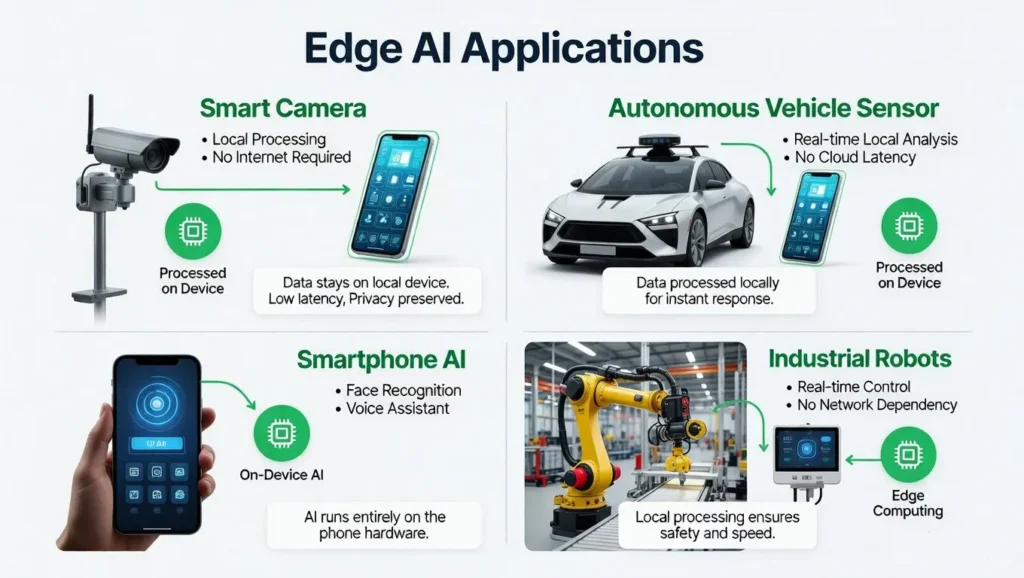
Modern smartphones use this technology for tasks such as face recognition, voice assistants, and camera enhancements. These features work instantly without sending sensitive data to the cloud.
🚗 Autonomous Vehicles
Self-driving cars rely heavily on local AI processing to analyze road conditions, detect obstacles, and make driving decisions in real time.
Even a small delay in processing could affect safety, making local AI processing essential.
🏭 Industrial Automation
Factories use this technology to monitor machinery and detect potential failures before they occur. Sensors can analyze equipment performance locally and alert operators immediately.
🏠 Smart Homes
Smart home devices such as security cameras, smart speakers, and home automation systems use on-device AI to recognize voice commands and detect unusual activity.
🏥 Healthcare Devices
Medical devices equipped with this technology can monitor patient data in real time and assist doctors in detecting abnormalities quickly.
✔ Benefits of Edge AI
⚡ Faster Processing
Because data is processed locally, on-device AI reduces the time required to send information to remote servers and receive results.
🔐 Improved Privacy
Sensitive information does not need to be transmitted to external servers, helping protect user data.
📶 Reduced Internet Dependency
Edge computing AI devices can continue operating even when internet connectivity is limited or unavailable.
💰 Lower Bandwidth Costs
Processing data locally reduces the amount of information transmitted over networks, lowering operational costs.
⚠️ Challenges of Edge AI
Despite its advantages, this technology also faces several challenges:
- Limited processing power compared to cloud servers
- Hardware constraints on small devices
- Difficulty updating AI models across many devices
- Security risks if devices are compromised
Researchers and engineers are working on improving hardware and software solutions to overcome these limitations.
🔮 The Future of Edge Computing AI
Edge AI is expected to play a major role in the future of technology. As devices become more powerful and efficient, more AI applications will move from the cloud to the edge.
Emerging technologies such as 5G networks, advanced sensors, and specialized AI chips will accelerate the adoption of Edge AI across industries.
From smart cities and autonomous vehicles to healthcare monitoring and environmental tracking, Edge AI will enable faster, smarter, and more responsive systems.
For a deeper understanding, you can explore how edge AI works according to IBM.
🏁 Conclusion
Edge AI represents an important shift in how artificial intelligence systems operate. By bringing AI processing closer to where data is generated, Edge AI enables faster decision-making, improved privacy, and greater efficiency.
As the number of connected devices continues to grow, Edge AI will become an essential part of the digital ecosystem, helping power the next generation of intelligent technologies.