

Introduction
Quantum artificial intelligence is an emerging field that combines the power of quantum computing with artificial intelligence to solve complex problems faster and more efficiently. In this guide, we will explain how quantum AI works, its benefits, real-world applications, and its future impact on technology.
Table of Contents
This is where quantum computing enters the picture. Quantum computers operate very differently from traditional computers and have the potential to solve extremely complex problems much faster.
When artificial intelligence and quantum computing are combined, the result is Quantum Artificial Intelligence (Quantum AI). This emerging field could dramatically improve how machines learn, analyze data, and make decisions.
What Is Quantum Artificial Intelligence?
Quantum Artificial Intelligence refers to the integration of quantum computing technologies with artificial intelligence systems.
Bits that indicate either 0 or 1 are used in traditional computers. Quantum bits (qubits), which are used in quantum computers, are capable of representing several states at once because of quantum characteristics including superposition and entanglement.
Because of this capability, quantum computers can process certain calculations much faster than classical computers.
By combining this power with AI algorithms, researchers hope to create systems capable of solving extremely complex problems that are difficult for traditional machines.
How Quantum Computing Enhances Artificial Intelligence
Quantum computing could significantly improve artificial intelligence in several ways.
1. Faster Data Processing
AI systems often require huge datasets to train machine learning models. Quantum computers may process and analyze this data much faster than classical computers.
This could reduce training time for complex AI models.
2. Solving Complex Optimization Problems
Many AI applications involve optimization tasks, such as planning delivery routes or managing energy systems.
Quantum computers can evaluate many possibilities simultaneously, making them well suited for solving optimization problems more efficiently.
3. Improved Machine Learning Models
Quantum machine learning is a growing research area where quantum computing helps improve machine learning algorithms.
Researchers are exploring ways to use quantum algorithms to speed up pattern recognition and predictive modeling.
Quantum Machine Learning
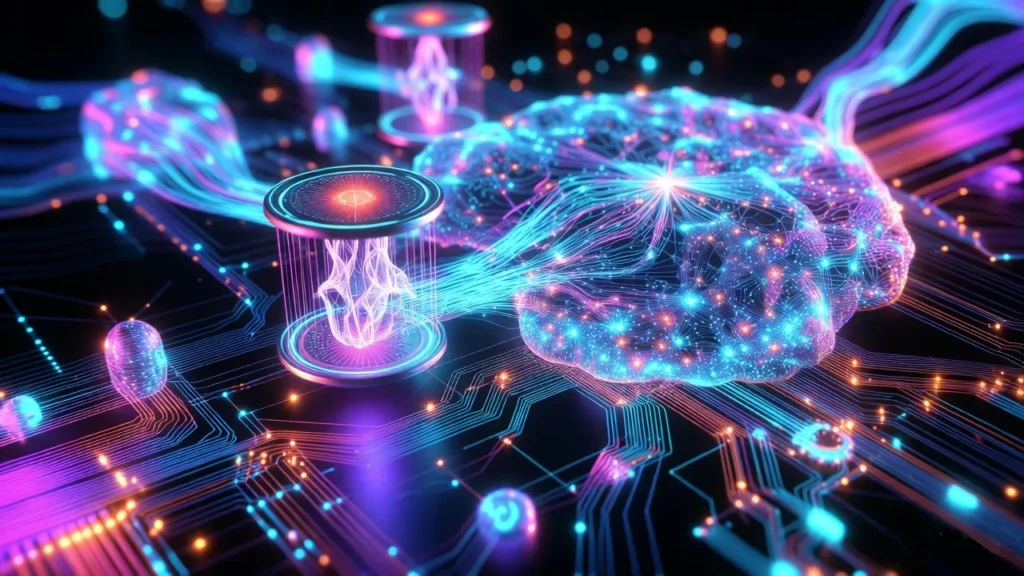
Quantum machine learning is a specialized area that focuses on applying quantum computing to machine learning tasks.
Some potential benefits include:
- Faster model training
- Improved pattern recognition
- Better handling of large datasets
- More efficient data classification
Although still in early stages, quantum machine learning could revolutionize how AI systems learn from data.
Potential Applications of Quantum AI
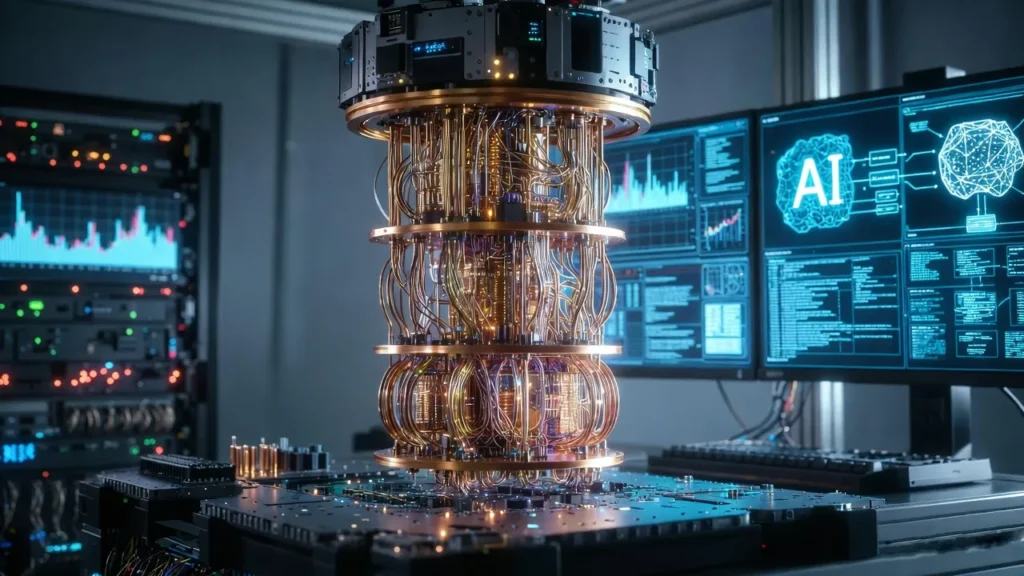
Quantum AI could impact many industries in the future.
1. Healthcare
Quantum AI could analyze complex biological data and help researchers develop new medicines more quickly.
It may also improve disease detection by analyzing medical imaging and patient data more efficiently.
2. Financial Services
Financial institutions could use quantum AI for risk analysis, fraud detection, and investment optimization.
The ability to analyze massive financial datasets quickly could lead to better decision-making.
3. Climate and Environmental Research
Quantum AI could help scientists simulate climate systems and develop better environmental models to understand global climate change.
4. Scientific Research
Many scientific problems require extremely complex simulations. Quantum AI could help researchers simulate molecules, materials, and physical systems more accurately.
Challenges of Quantum Artificial Intelligence
Despite its potential, quantum AI still faces several challenges.
1. Limited Hardware
Quantum computers are still in the early stages of development and are not yet widely available.
2. High Cost
Building and maintaining quantum computing systems is extremely expensive and requires specialized environments.
3. Algorithm Development
Researchers are still developing algorithms that can fully utilize quantum computing for AI tasks.
As technology advances, these challenges may gradually be overcome.
The Future of Quantum AI
Quantum artificial intelligence is still an emerging field, but it has enormous potential. As quantum hardware improves and researchers develop more advanced algorithms, quantum AI could become a powerful tool for solving complex global problems.
In the future, industries such as healthcare, finance, transportation, and energy may benefit from the combination of quantum computing and artificial intelligence.
Although widespread use may still be years away, quantum AI represents one of the most exciting frontiers in modern technology.
Conclusion
Quantum artificial intelligence brings together two of the most advanced technologies in the world: quantum computing and artificial intelligence. By leveraging the unique capabilities of quantum computers, AI systems could become faster, more efficient, and capable of solving problems that are currently impossible for classical computers.
As research continues, quantum AI could play a major role in shaping the future of science and technology.