

Introduction
Artificial Intelligence, Machine Learning, and Deep Learning are often used interchangeably, but they are not the same thing. For beginners, this can be confusing—especially when these terms appear in news articles, tech blogs, and product descriptions.
In this article, we’ll clearly explain the difference between AI, Machine Learning, and Deep Learning, using simple language and real-world examples.
What Is Artificial Intelligence (AI)?
Artificial Intelligence (AI) is the broadest concept among the three. It refers to machines or software designed to perform tasks that normally require human intelligence.
These tasks include:
- Understanding language
- Recognizing images
- Making decisions
- Solving problems
AI does not mean machines are conscious or think like humans. Most AI systems today are designed to perform specific tasks only.
Examples of AI:
- Voice assistants
- Recommendation systems
- Chatbots
- Image recognition software
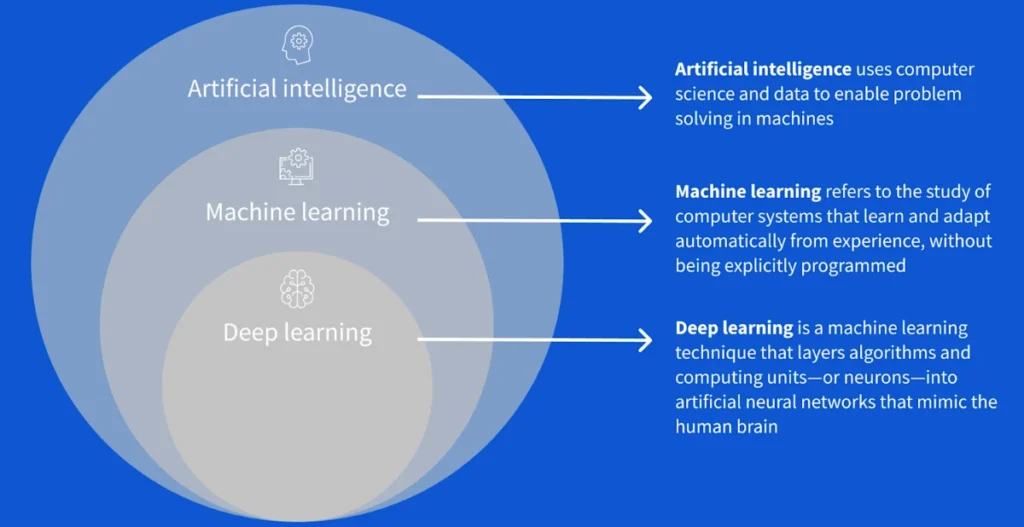
AI is the umbrella term that includes both Machine Learning and Deep Learning.
What Is Machine Learning?
Machine Learning (ML) is a subset of Artificial Intelligence. It focuses on systems that learn from data and improve over time without being explicitly programmed for every rule.
Instead of following fixed instructions, Machine Learning models:
- Analyze data
- Find patterns
- Make predictions
- Improve with experience
If Artificial Intelligence is the goal, Machine Learning is one of the main ways to achieve it.
Examples of Machine Learning:
Email spam filters
Product recommendations
Credit card fraud detection
Personalized ads

What Is Deep Learning?
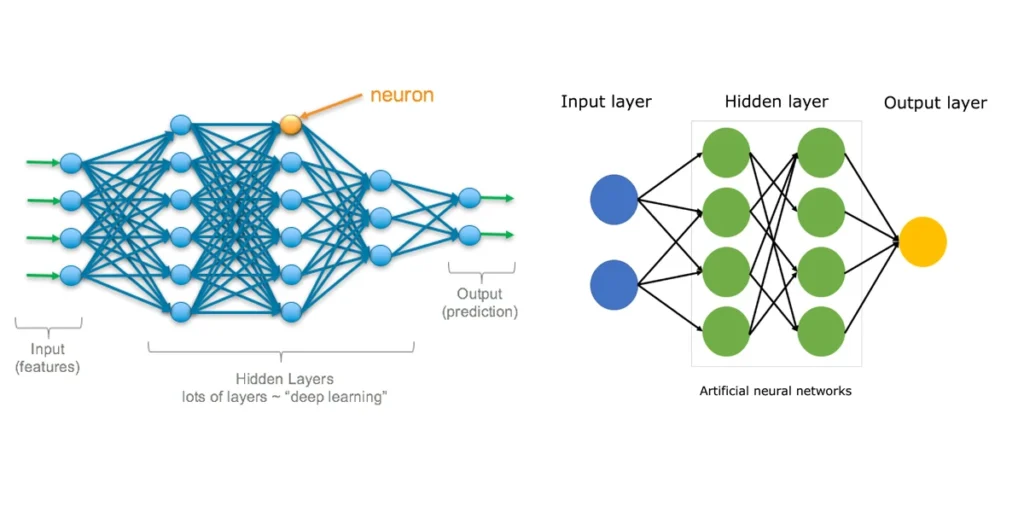
Deep Learning is a specialized subset of Machine Learning. It uses complex algorithms called neural networks, inspired by how the human brain works.
Deep Learning models:
- Have multiple layers (deep networks)
- Process massive amounts of data
- Perform especially well with images, audio, and video
Deep Learning is responsible for many recent breakthroughs in AI.
Examples of Deep Learning:
Facial recognition
Speech recognition
Self-driving car vision systems
Medical image analysis
Key Differences Between AI, Machine Learning, and Deep Learning
Here’s a simple way to understand the relationship:
- Artificial Intelligence → The big goal (making machines intelligent)
- Machine Learning → A method to achieve AI
- Deep Learning → An advanced method within Machine Learning
Comparison Table (conceptual)
| Aspect | Artificial Intelligence | Machine Learning | Deep Learning |
|---|---|---|---|
| Scope | Broadest | Subset of AI | Subset of ML |
| Data dependency | May or may not | Requires data | Requires large data |
| Complexity | Varies | Moderate | High |
| Human intervention | More | Less | Very little |
Real-World Example to Understand the Difference
Let’s take email spam detection:
- AI: The system aims to identify spam emails.
- Machine Learning: It learns from past spam and non-spam emails.
- Deep Learning: It analyzes complex language patterns and context to improve accuracy.
Each layer builds on the previous one.
When Is Each One Used?
- AI is used when decision-making or automation is required.
- Machine Learning is used when systems need to improve using data.
- Deep Learning is used when tasks involve images, speech, or complex patterns.
Not every problem needs Deep Learning. Sometimes, simpler Machine Learning models work better and are more efficient.
Common Myths About AI, ML, and DL
Myth 1: AI means robots
Reality: Most AI systems are software, not robots.
Myth 2: Deep Learning is always better
Reality: It requires more data and computing power and is not always necessary.
Myth 3: AI can think like humans
Reality: AI systems only follow data and algorithms.
How These Technologies Work Together
In practice, AI systems often combine:
- Rule-based logic
- Machine Learning models
- Deep Learning techniques
This layered approach allows systems to be both efficient and accurate.
Future of AI, Machine Learning, and Deep Learning
These technologies will continue to:
- Improve healthcare diagnostics
- Enhance education and research
- Automate complex processes
- Support scientific discoveries
Understanding their differences helps individuals and businesses use them responsibly.
Final Thoughts
Artificial Intelligence, Machine Learning, and Deep Learning are closely related but serve different purposes. AI is the broader vision, Machine Learning enables systems to learn, and Deep Learning pushes the limits of what machines can achieve.
For beginners, remembering their relationship is enough to build a strong foundation.