
Introduction
A firewall is one of the most important tools used to protect computers and networks from cyber threats. In today’s connected world, where data is constantly transmitted over the internet, having a reliable firewall is essential for security.
Table of Contents
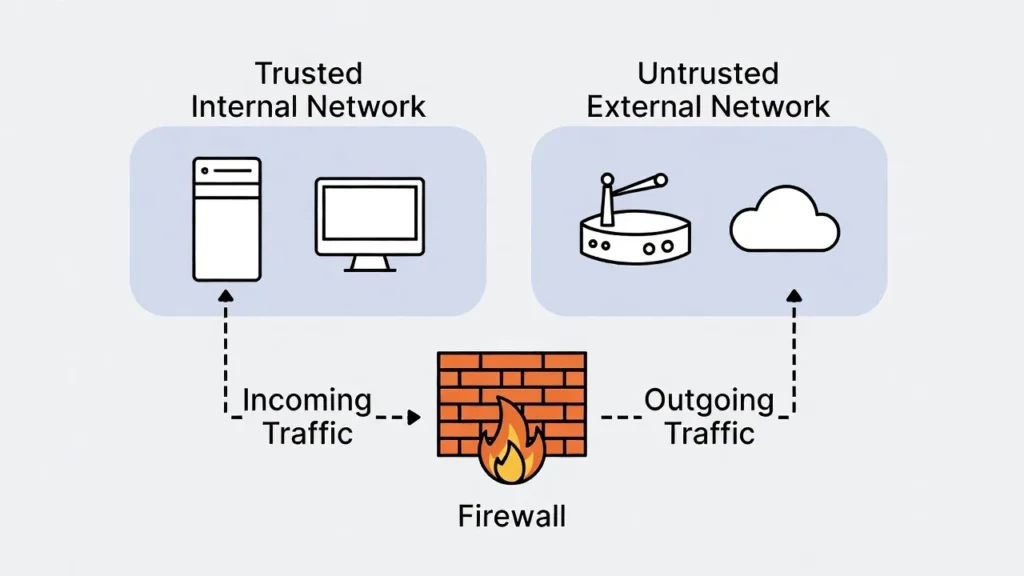
A firewall acts as a barrier between a trusted internal network and untrusted external networks. It monitors incoming and outgoing traffic and blocks suspicious activity.
Understanding how a firewall works can help individuals and organizations protect their systems from hackers and malicious attacks.
What Is a Firewall?
A firewall is a security system that monitors and controls network traffic based on predefined rules.
It can be implemented as hardware, software, or a combination of both. The main purpose of a firewall is to prevent unauthorized access while allowing legitimate communication.
Firewalls are widely used in homes, businesses, and data centers to enhance network security.
How Firewall Works
To understand how a firewall works, it is helpful to look at its basic functions.
Traffic Monitoring
A firewall inspects all incoming and outgoing data packets.
Rule-Based Filtering
The firewall applies security rules to determine whether traffic should be allowed or blocked.
Threat Prevention
Suspicious or harmful traffic is blocked to prevent cyberattacks.
This process happens continuously to keep systems secure.
Types of Firewalls
There are different types of firewall systems used in cybersecurity.
Packet Filtering Firewall
This type checks data packets and allows or blocks them based on rules.
Stateful Inspection Firewall
It monitors active connections and makes decisions based on the state of the connection.
Proxy Firewall
Acts as an intermediary between users and the internet.
Next-Generation Firewall
Advanced firewall systems that include features like intrusion detection and deep packet inspection.
Benefits of Firewall
Using a firewall provides several advantages.
Network Security
A firewall protects networks from unauthorized access.
Threat Prevention
It helps block malware, hackers, and malicious traffic.
Data Protection
Sensitive information remains secure with a firewall in place.
Access Control
Organizations can control which users and applications can access the network.
Applications of Firewall
A firewall is used in many environments.
Home Networks
Protects personal devices from online threats.
Business Networks
Ensures secure communication within organizations.
Cloud Systems
Cloud platforms use firewall systems to secure data.
Challenges of Firewall
Despite its benefits, a firewall also has limitations.
Configuration Complexity
Incorrect settings can reduce effectiveness.
Limited Protection
A firewall alone cannot protect against all types of attacks.
Performance Impact
Heavy filtering may slow down network performance.
Firewall vs Other Security Tools
A firewall works alongside other cybersecurity tools such as:
- Antivirus software
- Encryption systems
- Intrusion detection systems
Together, these tools create a strong security system.
The Future of Firewall Technology
The future of firewall technology is evolving with artificial intelligence and advanced threat detection systems.
Modern firewalls are becoming smarter and more capable of identifying complex cyber threats in real time.
Modern firewall systems are also integrating cloud-based security and automation to handle increasing network complexity. With the rise of remote work and distributed systems, firewalls are no longer limited to physical devices but are now part of cloud infrastructure. This shift allows organizations to monitor and secure networks from anywhere. In addition, advanced firewall solutions use machine learning to detect unusual patterns and respond to threats more effectively, making cybersecurity systems more proactive rather than reactive.
Conclusion
A firewall is a critical component of modern cybersecurity that helps protect networks and devices from unauthorized access and cyber threats. By monitoring traffic and enforcing security rules, a firewall ensures safe communication over the internet.
In addition to basic protection, a firewall plays an important role in building a layered security strategy. When combined with other technologies such as antivirus software and encryption, it creates a stronger defense against modern cyber threats. As digital environments continue to evolve, individuals and organizations must ensure that their firewall systems are properly configured and regularly updated. A well-maintained firewall can significantly reduce the risk of cyberattacks and help maintain a secure online experience.
As cyber threats continue to grow, the importance of firewall technology will only increase.