

AI and jobs are becoming one of the most discussed topics in 2025 as artificial intelligence transforms the global workforce. What was once considered a futuristic concept has now become a powerful force reshaping industries, automating repetitive tasks, and enabling groundbreaking innovations. As AI adoption continues to grow, an important question arises: is your job safe?
AI and jobs are closely connected, as this technology is impacting almost every sector—from customer service and software development to creative fields. This blog explores how AI is changing employment, which jobs are most at risk, which roles remain resilient, and how you can prepare for the future. Understanding AI and jobs is essential for building a secure and long-term career.
The employment market is rapidly evolving due to advancements in technologies such as generative AI, machine learning, and natural language processing. Recent reports suggest that while AI may replace certain tasks, it is also creating new opportunities across industries. To better understand AI and jobs, let’s explore the latest trends and insights shaping the future of work.
To understand this topic better, it’s important to learn what artificial intelligence is and how it works.
Table of Contents
The Impact of AI on the Job Market and Employment Opportunities
AI and jobs are reshaping the labor market by increasing productivity and streamlining business processes across industries. A 2025 study from the University of San Diego shows that nearly two in five U.S. workers are already using AI in their roles, with entry-level employees leading the adoption. This growing connection between AI and jobs is driven by the technology’s ability to automate repetitive tasks, analyze large datasets, and deliver insights much faster than traditional methods.
For example, in recruiting, AI systems are transforming hiring by scanning resumes, predicting candidate success, and even conducting initial interviews. This clearly shows how AI and jobs are evolving together in modern workplaces. According to global research by J.P. Morgan, AI may slow job growth in certain sectors, especially those that rely heavily on routine tasks. The McKinsey Future of Work report for 2025 also highlights that factors like employee training and organizational readiness will play a key role in how AI and jobs develop in the future.
This shift is already visible, as reported by Forbes, where roles involving data entry, customer support, and basic coding are among the first to be automated. However, AI is not just replacing jobs—it is also creating new opportunities. The World Economic Forum’s Future of Jobs Report 2025 states that while many companies expect workforce reductions, new roles in data science, machine learning, and AI ethics are rapidly emerging.
Overall, AI and jobs have a dual impact: they reduce repetitive work while boosting productivity and innovation in other areas. Research from Stanford’s Digital Economy Lab suggests that job displacement is more common among roles with high exposure to automation, but at the same time, new career paths are being created. This balance shows that AI and jobs are evolving together, shaping a dynamic and changing future of work.
Industries Most Affected by AI
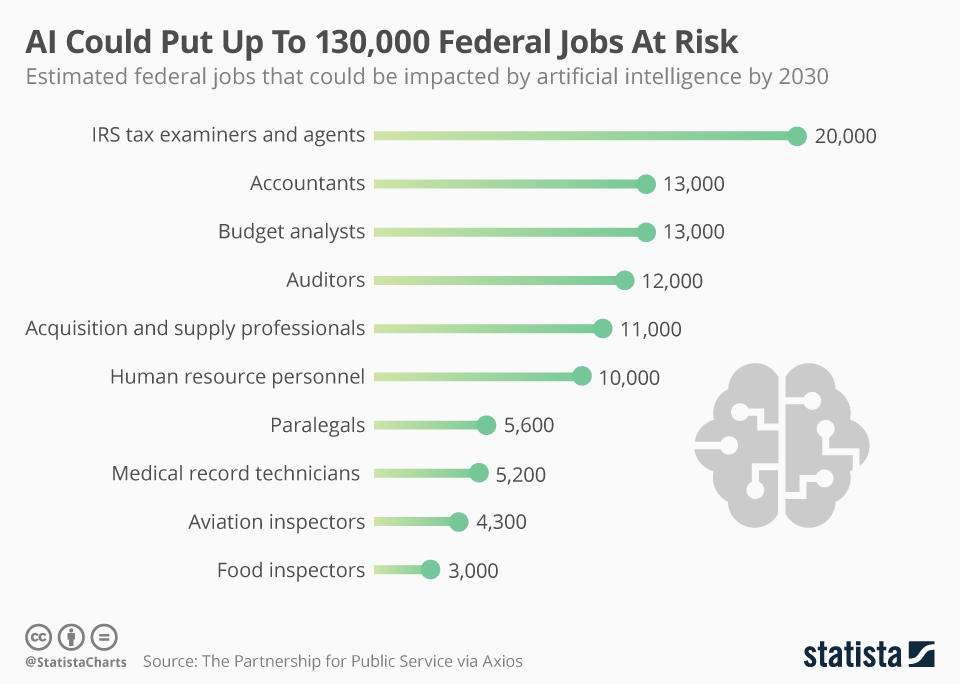
AI is not impacting all industries equally. Some sectors are more vulnerable due to the nature of their tasks, while others are embracing AI to enhance operations. According to post published by Statistica; AI Could Put Up to 130,000 Federal Jobs At Risk
- Customer service and support: For simple questions, AI chatbots and virtual assistants are taking the place of human workers. According to Forbes, by 2030, AI will handle up to 80% of everyday contacts, making customer service positions among the first to be automated.
- Software Development: Entry-level coding activities are being automated by AI solutions like GitHub Copilot. The Stanford analysis finds losses in employment for 22-25 year-old workers in AI-exposed jobs, including software development.
- Manufacturing and Logistics: Robots driven by AI and predictive analytics are optimizing supply chains and assembly lines. TechTarget’s infographic illustrates that manufacturing is highly automatable, with AI non-automated employment being confined to creative oversight.
- Finance and Accounting: AI reduces the need for manual bookkeeping because it is excellent at data analysis and fraud detection. J.P. Morgan’s research shows that AI will redefine job growth in finance, with a concentration on high-skill professions.
- Retail and Sales: Sales personnel are impacted by AI-driven inventory management and personalized recommendations. Retail is one of the industries most affected by AI, according to the Visual Capitalist chart.
According to Statista, AI could put up to 130,000 federal jobs at risk in the US, primarily in administrative and data entry professions. The Observer points out that while fewer significant changes are occurring in sectors like healthcare and education, knowing AI is crucial for career resilience.
In summary, sectors with repetitive, data-heavy jobs are most affected, with forecasts from McKinsey predicting that by 2025, AI deployment will depend on organizational issues outside technology.
For deeper insights, you can explore global trends in AI and jobs from the World Economic Forum.
Jobs That Are Safe from AI
While AI is automating many roles, certain jobs are inherently resistant due to their need for human qualities like creativity, empathy, and complex decision-making.
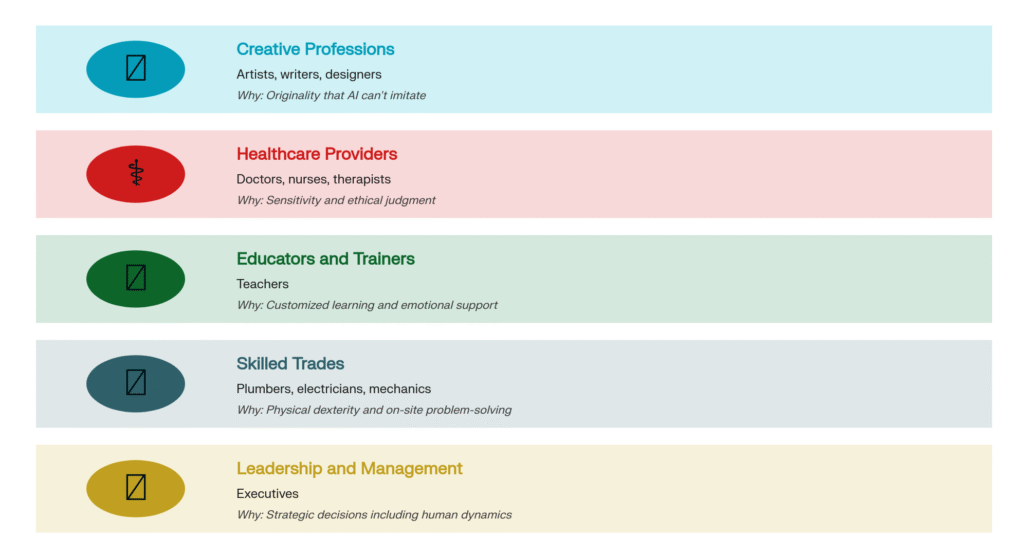
- Creative Professions: Artists, writers, and designers rely on originality that AI can’t imitate. Ajelix’s infographic classifies creative occupations as safe, as AI lacks actual innovation.
- Healthcare Providers: Doctors, nurses, and therapists demand sensitivity and ethical judgment. The TechTarget report depicts healthcare as less automatable, with AI supporting rather than replacing.
- Educators and Trainers: Teachers customize learning in ways AI can’t, relying on emotional support. While AI helps education, human interaction is still crucial, according to the University of San Diego.
- Skilled Trades: Plumbers, electricians, and mechanics need physical dexterity and on-site problem-solving. Visual Capitalist’s chart indicates trades as low-impact zones.
- Leadership and Management: Executives make strategic decisions including human dynamics. High-level managerial positions are safe, according to Stanford’s analysis
As per HubSpot, jobs safe from AI include those with high human touch, like counselling and art therapy. The Inc. Magazine article adds that entry-level hires are adapting faster, but roles requiring interpersonal skills remain secure.
In essence, jobs involving human emotions, creativity, and physical work are safer, while routine tasks are at risk
How to Prepare for the AI-Driven Job Market

To thrive in an AI-reshaped workforce, proactive preparation is essential. Here’s how to future-proof your career:
- Learn AI Fundamentals: Familiarize yourself with AI principles through online classes. Brian Vander Waal’s guide offers crucial AI skills like machine learning and data analysis for career security.
- Upskill in AI-Resistant Areas: Focus on creativity, emotional intelligence, and strategic thinking. The World Economic Forum suggests training programs to adapt to AI automation.
- Integrate AI in Your Work: Use AI tools to boost productivity. Forbes suggests mastering AI to prevent being replaced, as technology may automate boring chores, saving time for high-value work.
- Stay Informed on Trends: Follow reports from McKinsey and J.P. Morgan on AI’s job impact. According to the Observer, career resiliency is mostly dependent on regular upskilling.
- Build a Network: Connect with AI professionals and join communities. According to TechTarget, some employees are not worried about AI replacing them if they can adapt
The LockedIn AI blog highlights trends like AI in US job markets, suggesting that preparation involves embracing AI rather than fearing it. By investing in continuous learning and leveraging AI as a tool, you can secure your position in the evolving job market
Conclusion
AI is certainly transforming the workforce, with both difficulties and opportunities. Some jobs are changing or being created, while others are under danger. By identifying the patterns, assessing your role’s vulnerability, and preparing accordingly, you may manage this shift successfully. The key is adaptability—embrace AI as an ally, not an enemy, and your work will not only be safe but prosper in the years ahead.